

Memory is my act of resistance
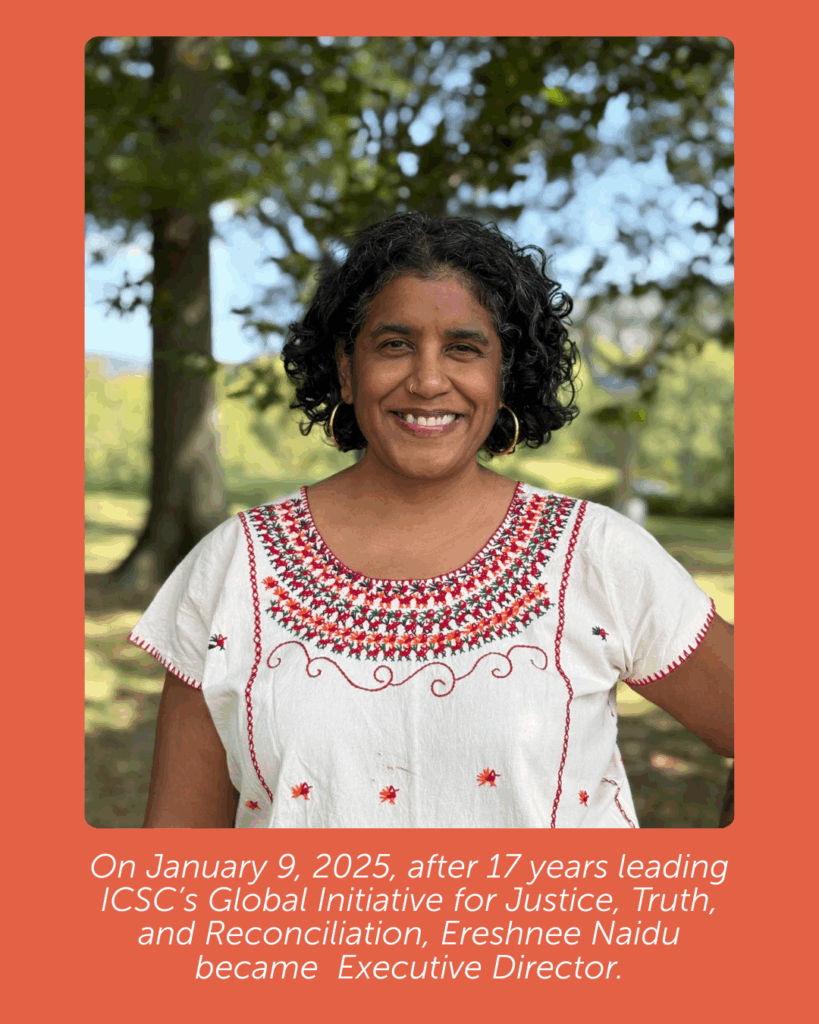
Dear Friends
History has shown us that repressive regimes rise and fall but it is the individual acts of kindness, empathy and resistance that provide pathways for inspiration, celebration and answers the question that I hear so often in this moment: “What can I do to make a change?”
The world has carried me across places and experiences, yet my heart has always known where it belongs: in memory and justice. The story of the Sierra Leonean baker who risked his life, making daily rounds in his neighborhood providing free bread for his neighbors who were seeking shelter during an active civil war, and the old Sri Lankan woman who daily fed her neighbors who were being targeted by a repressive regime because of their minority status, will stay with me, inspiring to continue my work, and scaffolding my faith in humanity. My own story, one that eventually led me on my path to ICSC, began when I was just nine years old, barely making sense of life in Apartheid South Africa, when I witnessed a secret act of defiance that would shape my dedication to justice.
Under the cover of night, I heard my father slip out of our house, and a hushed warning from my mom for him to be careful. I would later find out that these regular departures at night were when he left home to print, in the dark, anti-apartheid materials for the Natal Indian Congress and the African National Congress. The quiet rustle of contraband pamphlets being hidden between a mattress and box spring, the urgent press of his finger to his lips—these were the gestures of silent resistance, the unspoken language of a man determined to protect his family and fight for justice, even though he did not consider himself “political”.
But my father was not alone. Behind his solitary actions, there was a vast network of dedicated individuals – citizens, human rights activists, memory workers, professionals, politicians, and supporters from around the world – all united in a shared goal to dismantle apartheid’s oppressive hold on South Africa. Together, they formed a powerful movement, a force of collective will and unwavering resolve to create change.
Memory Is My Act of Resistance
Growing up in a sheltered Indian community designated by the apartheid government, my parents protected me from the full brunt of the oppressive system. Still, I remember watching from a distance as ocean waves crashed against the beach we were forbidden to enter, and the whispers of violence and disappearances outside our segregated community lingered in the air.
At 16, on June 18, 1992, the brutal massacre of 45 people in Boipatong shattered my peaceful existence. While this was an event between rival political parties, the root cause was the divide-and-rule strategy of the Apartheid government. Years later, testimony at the Truth and Reconciliation Commission would also reveal the role of the police in the violence. Why that act of violence pierced my peaceful community–I do not know. But I instinctively knew that the time for silence had ended. I organized my high school to remember the victims of the Biopatong massacre and document the events of June 17, 1992. This act marked the beginning of my life in activating memory to preserve truth and pursue justice.
When I joined the International Coalition of Sites of Conscience seventeen years ago, it was because of my personal experience. I saw what happens when histories are erased and truths are denied. The fabric of democracy frays, injustice thrives, and violence takes hold. Every silenced story is a victory for authoritarianism. But when we activate memory to preserve the truth, we resist tyranny and prevent repetition. When a global network of museums, historic sites, survivors, activists, and communities takes the lead in shaping history, upholding truth, seeking justice, and ensuring accountability, democratic societies flourish.
Memory Can Be Your Act of Resistance
Today, we face unprecedented challenges – more than 72% of the global population lives under regimes that undermine democratic principles. This rise in authoritarianism is paired with a calculated effort by authoritarian governments to rewrite history, suppress uncomfortable truths, and erase collective memory. Despite memory being considered a “soft issue” within the human rights and justice framework, it is memory that can transform survivors’ pain into accountability; it is a witnessing against injustice, hence the new “war on memory.”
We must stand together to defend against this assault on our shared past.
As someone who has witnessed the power of memory in pursuing justice and truth, I ask that you give today. Your support can help build a global coalition that refuses to allow any community to face attacks in isolation, one that centers on survivors’ perspectives, and one that champions the transformative power of history.
Together, we can ensure that the lessons of the past are not forgotten, that the voices of the silenced are heard, and that the flame of memory burns bright against the darkness of authoritarianism. Please stand with us in defense of collective memory, truth, and justice. Your commitment today can shape a more just and resilient future for generations to come.
Sincerely,
Ereshnee Naidu
Executive Director